



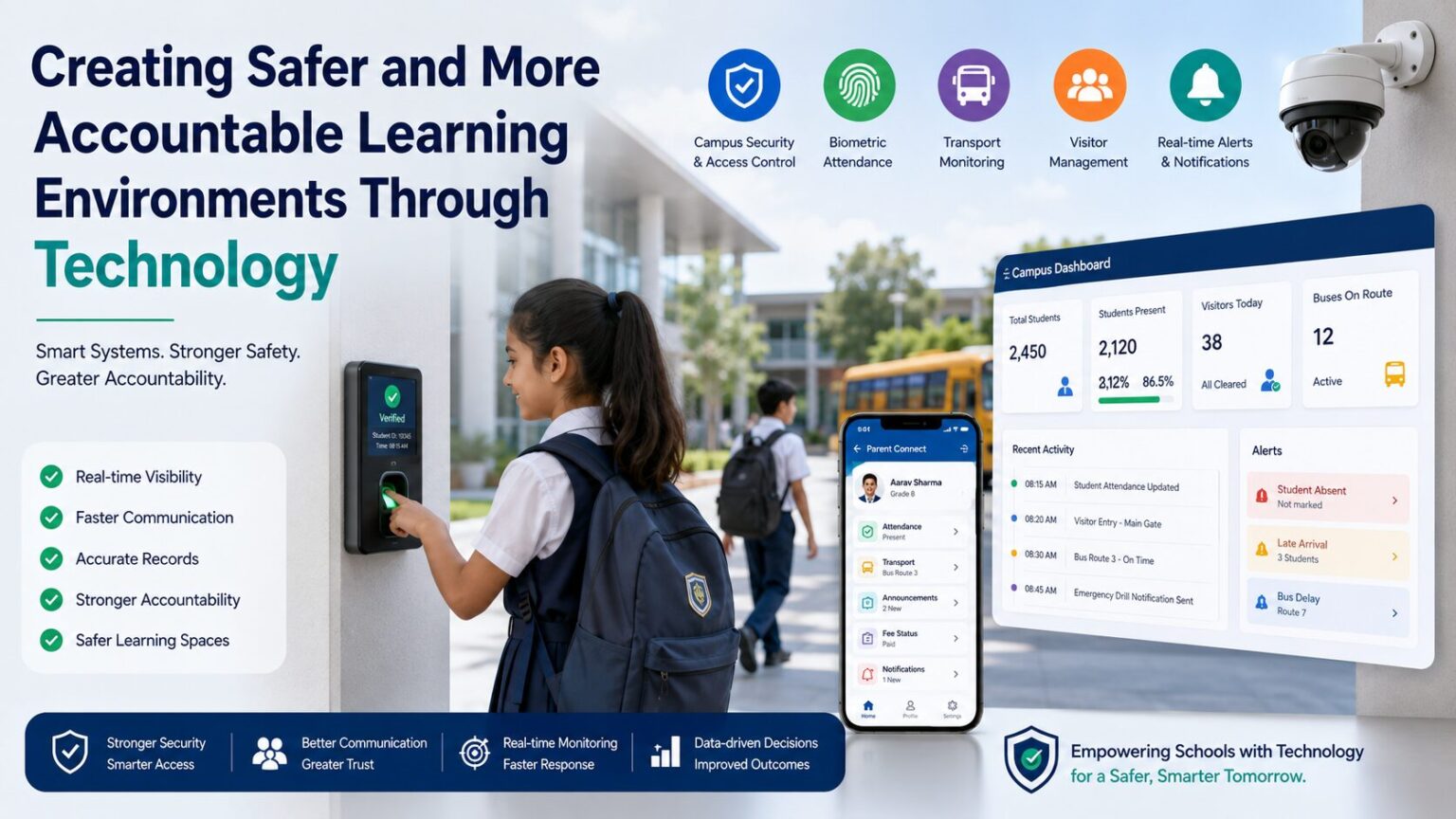
Educational institutions are focusing more on safety, accountability, and operational transparency than ever before. Schools now manage large student populations, multiple campuses, transportation systems, and daily visitor movement. Manual monitoring methods often create delays and reduce visibility into important activities. To improve operational control and student accountability, many institutions are adopting school software that helps centralize monitoring, communication, and administrative coordination.
Campus Security Is No Longer Limited to Physical Gates
School safety has evolved significantly over the years.
Educational institutions must now monitor:
- Student attendance
- Visitor access
- Transport movement
- Staff coordination
- Emergency communication
- Campus activity records
Traditional security methods often rely heavily on manual supervision and paper-based reporting.
While physical security remains important, schools now require digital systems that improve real-time visibility across the institution.
Technology helps schools respond faster to operational concerns while improving coordination between departments.
Delayed Information Can Create Serious Problems
Many operational issues begin with delayed reporting.
When attendance updates or communication records are not available quickly, schools may struggle to respond to concerns in time.
For example:
- Parents may not know a student is absent
- Administrators may miss attendance trends
- Visitor tracking records may remain incomplete
- Emergency communication may slow down
Digital systems improve response speed by centralizing operational information in real time.
This strengthens institutional accountability and improves operational awareness throughout the day.
Attendance Monitoring Supports Student Safety
Attendance management is closely connected to campus accountability.
Schools must know which students are present at all times.
Manual attendance methods often create:
- Delayed updates
- Incomplete records
- Human errors
- Reporting inconsistencies
To improve accuracy and operational visibility, many institutions now use a school biometric attendance system that automates attendance verification and reduces manual dependency.
Biometric systems help schools track student presence more accurately while improving reporting reliability.
Parents and administrators also receive faster attendance updates through centralized systems.
Parents Expect Greater Transparency
Modern parents want more visibility into school operations and student activities.
Families now expect schools to provide timely updates regarding:
- Attendance status
- Arrival and departure timing
- Academic schedules
- School announcements
- Emergency notifications
Traditional communication methods often fail to deliver information quickly enough.
Digital platforms improve communication by sending automated updates directly to parents.
This creates stronger trust between schools and families while improving operational transparency.
Visitor Management Has Become More Important
Educational institutions receive many visitors daily.
These may include:
- Parents
- Vendors
- Maintenance teams
- Guests
- External staff
Manual visitor tracking methods often create security gaps.
Schools may struggle to maintain accurate entry and exit records.
Digital monitoring systems improve visitor management through centralized access logs and tracking tools.
This strengthens campus accountability and helps schools maintain safer operational environments.
Technology Helps Schools Respond Faster During Emergencies
Emergency preparedness is an important part of modern school management.
Institutions must respond quickly during situations involving:
- Medical emergencies
- Transport delays
- Security concerns
- Weather-related incidents
- Operational disruptions
Delayed communication can create confusion during critical moments.
Centralized digital systems improve emergency coordination through real-time communication and operational visibility.
Schools can quickly notify parents, teachers, and support staff when urgent updates are required.
This improves response efficiency and strengthens institutional preparedness.
Transport Monitoring Improves Student Accountability
Student transportation is another area where schools require better operational visibility.
Manual transport coordination often creates communication gaps and delays.
Parents may struggle to track bus arrival timing or student boarding activity.
Digital monitoring systems improve transport accountability through centralized tracking and communication tools.
Schools can maintain better visibility into:
- Vehicle movement
- Route activity
- Student boarding records
- Transport schedules
This improves operational coordination and parent confidence.
Multi Campus Institutions Need Unified Monitoring
Educational groups operating multiple campuses face greater operational complexity.
Different branches may follow separate monitoring processes and reporting standards.
This creates inconsistencies and limits centralized oversight.
Digital platforms help institutions standardize operational monitoring across campuses.
Leadership teams can review:
- Attendance activity
- Security updates
- Communication records
- Visitor tracking
- Operational incidents
from a single dashboard.
This improves institutional control and operational alignment across locations.
Administrative Teams Need Better Operational Visibility
Administrative staff handle many daily responsibilities related to campus operations.
These tasks often include:
- Attendance verification
- Communication coordination
- Visitor management
- Report preparation
- Incident tracking
Manual systems increase workload pressure and slow down operational response times.
Technology simplifies these responsibilities through automation and centralized information management.
This allows administrative teams to focus more on planning and student support instead of repetitive coordination tasks.
Reducing Human Error Improves Accountability
Manual operational systems increase the risk of mistakes.
Common problems may include:
- Missing attendance entries
- Incorrect records
- Delayed reporting
- Incomplete visitor logs
- Communication failures
These issues affect institutional transparency and operational reliability.
Automated systems improve accuracy through centralized databases and real-time synchronization.
When information updates within one department, it becomes visible throughout the institution immediately.
This reduces operational confusion and strengthens accountability.
Digital Records Improve Institutional Transparency
Educational institutions increasingly require organized and accessible operational records.
Schools may need information for:
- Internal reviews
- Parent communication
- Compliance reporting
- Incident investigations
- Administrative planning
Manual record management often makes retrieval difficult and time-consuming.
Digital systems simplify record organization and improve reporting accessibility.
Schools can retrieve operational history quickly while maintaining better documentation standards.
This supports stronger institutional transparency and operational trust.
Teachers Also Benefit From Better Monitoring Systems
Teachers spend significant time coordinating attendance, communication, and classroom management.
Manual systems often increase administrative pressure.
Digital platforms help teachers:
- Record attendance quickly
- Access student information instantly
- Receive operational alerts
- Communicate with parents efficiently
- Monitor classroom activity more effectively
This improves classroom coordination while reducing paperwork and repetitive administrative tasks.
Teachers can focus more on student engagement and learning activities.
Schools Are Moving Toward Real Time Operations
Modern educational institutions can no longer depend entirely on delayed reporting and disconnected systems.
Schools now require operational environments where information updates instantly.
Real-time systems improve visibility into:
- Student attendance
- Campus activity
- Communication workflows
- Safety monitoring
- Administrative coordination
This supports faster decision-making and stronger institutional management.
Schools also gain better operational flexibility as environments become more connected and technology-driven.
Data Visibility Helps Leadership Teams Plan Better
School leadership teams require accurate operational insights for planning and resource management.
Without centralized visibility, decision-making becomes slower and less reliable.
Digital platforms provide dashboards that help administrators monitor:
- Attendance patterns
- Campus operations
- Communication performance
- Resource usage
- Student activity trends
This improves institutional planning and operational efficiency.
Leadership teams can identify concerns earlier and respond more effectively.
Building a Culture of Accountability
Technology does more than automate operations. It also strengthens institutional accountability.
Students become more aware of attendance monitoring and operational expectations.
Staff members gain clearer operational responsibilities through centralized systems and digital workflows.
Parents receive greater transparency into daily school activity.
This creates a more organized and accountable educational environment for everyone involved.
The Future of School Safety and Operational Monitoring
Educational institutions continue evolving to meet modern operational expectations.
Schools now require connected systems that support communication, visibility, safety, and accountability in real time.
Technology is becoming a major part of how institutions manage student welfare and campus operations.
Schools investing in digital monitoring systems gain stronger operational control and improved responsiveness across departments.
As educational environments continue advancing, technology will play an even greater role in creating safer, more transparent, and more accountable learning spaces for students, teachers, administrators, and families.