



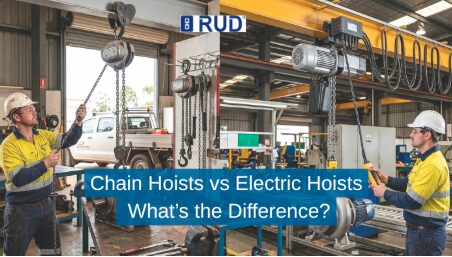
The main difference between chain hoists and electric hoists is how they’re powered. One uses manual effort through a hand chain, while the other uses an electric motor to handle the load automatically.
But if you’re deciding which one belongs in your facility, workshop, or job site, the impact is not limited to the power source. And the wrong choice can slow operations, increase operator fatigue, and create inefficiencies, especially in environments where lifting is frequent or time-sensitive.
We’ve seen it play out enough times to know. At RUD Australia, our engineers have spent over 40 years working across mining, construction, and heavy industry, and the hoist question comes up constantly. So we put together this guide to walk you through everything you need to weigh up before making a call.
By the end, you’ll know exactly how each hoist works, where each one performs best, and which one suits your application.
How Manual and Electric Chain Hoists Actually Work
Both manual and electric chain hoists lift loads using a chain and internal gearing system. The difference lies in how that lifting force is applied, either through manual input or an electric motor. Let’s take a closer look at how each system operates.
Manual Chain Hoists: The Pull-and-Lift Method
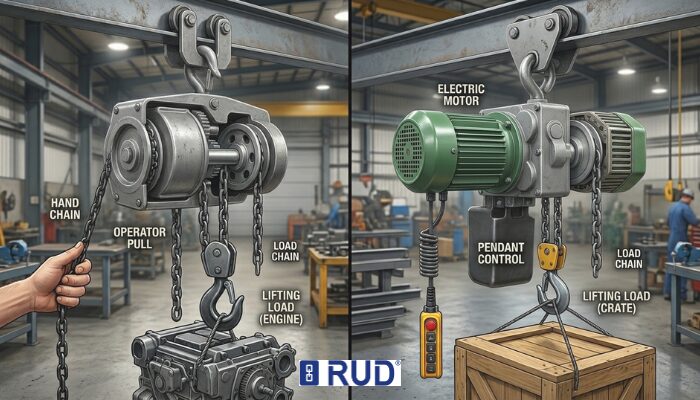
A manual chain hoist works through a simple gear system. When the operator pulls the hand chain, it turns a series of internal gears that wind the load chain and lift the attached load via the bottom hook.
Let’s say you’re carrying out a maintenance job on a Queensland mine site where running power to the lift point isn’t possible. In situations like this, a manual chain hoist lets you complete the lift without needing a generator.
That reliability extends to how the load is held, too. The mechanical brake engages the moment the operator stops pulling, so the load stays exactly where you leave it while you reposition.
Electric Chain Hoists: Motor-Driven and Built for Volume
An electric chain hoist uses an induction motor to convert electrical energy into mechanical force, driving the load chain up or down. The operator manages everything through a pendant or remote, so lifting a ton of steel is reduced to a simple button press.
In a busy warehouse or fabrication shop, that difference shows up in output. Operators aren’t physically pulling the chain on every lift. This means you can maintain more consistent cycle rates across a shift without fatigue becoming the limiting factor.
The system also locks the load automatically when power is released. The brake engages to hold position and prevents unintended movement during pauses or position changes. In practice, that means the operator isn’t constantly correcting or re-tensioning the load while it’s suspended.
Speed, Load Capacity, and Lifting Frequency Compared
The right hoist for your operation depends heavily on how often you’re lifting and how much weight you’re moving each time. In many cases, those two factors alone narrow the decision down quickly. Here’s how electric and manual hoists compare in real working environments:
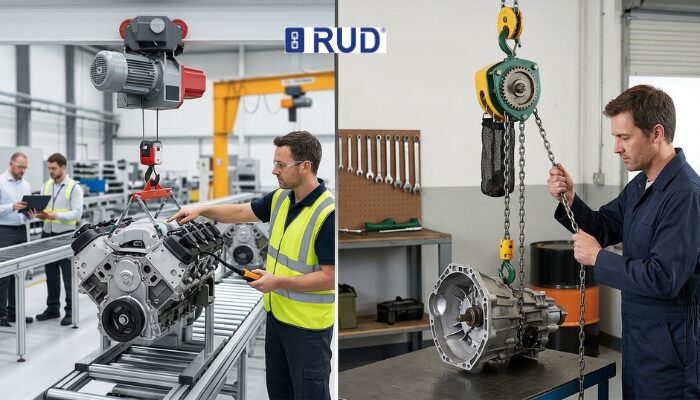
- Electric Hoists: Electric hoists are significantly faster and handle higher load capacities, which makes them ideal for high-frequency industrial environments. In an automotive assembly plant, for example, components need to be lifted and repositioned dozens of times per shift. A manual hoist rarely maintains that pace without increasing operator fatigue.
- Manual Hoists: Precision positioning is easier with a manual hoist because operators feel the load directly through the chain. Direct feedback like this makes them a practical choice for occasional lifts, lighter loads, and tasks where controlled movement is more important than speed.
- Fatigue and Repetitive Use: The physical effort required to pull the chain increases with load weight and frequency of use. Over long shifts, the accumulation can slow cycle times and increase the likelihood of handling errors.
In high-frequency lifting environments, electric hoists provide greater speed, consistency, and reduced physical strain. Manual hoists, however, still remain effective for lighter-duty applications where portability, control, or lower operating costs are more important than lifting speed.
Cost of Chain Hoists vs Electric Hoists
Manual chain hoists typically start from around $100 AUD for lighter-capacity models, with industrial-grade units reaching closer to $800 AUD. Because they don’t rely on motors or electrical systems, ongoing maintenance costs also remain relatively low. That makes them a practical option for smaller businesses or sites where lifting is infrequent.
Electric hoists, by comparison, generally range from around $800 to $5,000+ AUD depending on capacity, lifting speed, and control features. The addition of motors, gearboxes, and electrical components increases both upfront and servicing costs over time.
That said, operations running frequent lifting cycles each day often see productivity gains outweigh the higher initial investment within the first year of heavy use. We’ve seen this in practice with a client running 80-plus lifts a day on a Brisbane construction site. They cut manual handling incidents by a third within the first six months.
Ultimately, the right investment depends on how demanding your lifting operation is day to day.
Portability and Power Requirements
Not every lift happens in a fixed facility with a power outlet nearby. Sometimes the job is in a tight corner of a construction site, halfway up a structure, or in a location where running power simply isn’t practical. The table below compares how each hoist type performs under different site conditions:
| Feature | Manual Chain Hoist | Electric Chain Hoist |
| Power Source | None required | Single or three-phase electricity |
| Weight | Light, easily carried | Heavier, requires mounting |
| Installation | Anchor point only | Electrical wiring and mounting structure |
| Portability | High, relocate freely | Low, semi-permanent setups |
| Best Environment | Remote sites, outdoor, off-grid | Warehouses, factories, fixed facilities |
Often, site conditions influence hoist selection just as much as lifting capacity or speed. This is especially true on jobs where lift points change regularly, such as maintenance rounds across large facilities or multi-level construction work.
In these environments, a manual hoist can be repositioned quickly without rewiring or remounting, which saves time across the working week. Power availability also becomes a practical limitation in remote or temporary work areas, where installing electrical supply points may add unnecessary setup time and cost.
Safety Features and Height Safety Considerations
Both hoist types have built-in safety mechanisms, but they differ in operation and operator responsibility. These differences become clearer when you look at how each type manages load control and operational safety:
- Overload Protection and Electrical Safeguards: Electric hoists include overload protection, limit switches, and thermal motor protection as standard. These features automatically cut power when the hoist exceeds its rated capacity or operating temperature, which helps prevent mechanical failure before damage occurs.
- Mechanical Safety on Manual Hoists: With manual hoists, the operator carries more direct responsibility for safe use because the system relies on mechanical control rather than electronic safeguards. That reliance makes load awareness and proper training essential in variable lifting environments.
- Inspection and Recertification Requirements: Under Safe Work Australia guidelines, both manual and electric hoists require regular inspection, maintenance, and periodic recertification. These obligations apply regardless of hoist type, particularly in workplaces where lifting equipment is used frequently or in high-risk environments.
We recommend scheduling inspections and recertification through a competent person or licensed inspector in accordance with AS 2550 and AS 4991. Doing so helps ensure your equipment remains compliant and that your team is working with verified, serviceable lifting gear.
Which Chain Hoist Suits Your Operation?
The answer depends on four things: what you’re lifting, how often, where the job is, and whether reliable power is available at the lift point.
For instance, electric chain hoists are the stronger choice for fixed industrial environments where loads are heavy and cycle times affect overall output.
That’s because manufacturing facilities, warehouses, and fabrication shops running multiple lifts per shift depend on consistent, repeatable performance. The speed, reduced physical strain on your team, and built-in safety features make electric hoists well-suited to those demands.
That said, for less frequent or more mobile lifting tasks, manual chain hoists are the more practical option. They’re ideal for maintenance work, remote locations, and jobs requiring precise load positioning. Plus, you can deploy them quickly across different areas of a site as the work demands, without waiting for a power source or fixed installation.
If your operation falls somewhere in between, lifting frequency is usually the deciding factor. Occasional tasks with lighter loads are often handled well with a manual hoist, while daily high-cycle lifting justifies the move to electric.
Pro Tip: If you’re still not sure which way to go, count how many lifts your team does in a typical day. Once you exceed around 20 lifts per day, an electric hoist will often be the more cost-effective option.
Choose the Right Lifting Equipment Before the Job Demands It
Both manual and electric chain hoists are proven lifting equipment. The decision comes down to matching the right one to what your operation demands.
Start by assessing your lifting frequency, load requirements, site conditions, and power availability. Those four factors will narrow the field quickly and point you toward the hoist type that works for your operation. And if you’d like guidance from an experienced team, RUD Australia is here to help. We’re happy to talk through your application and point you in the right direction. Visit our website for more information.